United in Hockey, Driven by Community
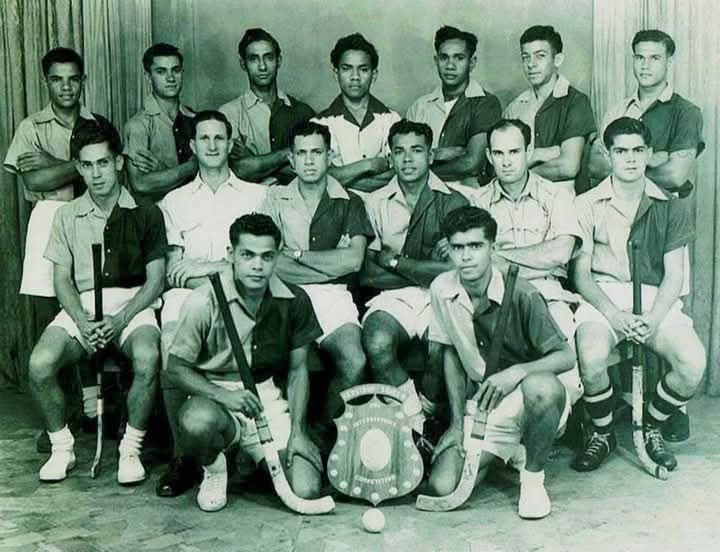
Lautoka Hockey Team of 1955
Our Story
How a Colonial Sport Became a Symbol of Unity in Fiji’s Sugar City
In the early 1920s, when Fiji was still firmly under British colonial rule, a new sport began to appear on the fields of Lautoka. Field hockey, already entrenched in Suva’s Albert Park and across the historical town of Levuka since 1916, arrived quietly at first. It was introduced by European administrators, who—much like their approach to cricket, rugby, football and tennis—kept the sport locked behind the walls of racial segregation.
To play hockey in Lautoka in those early years meant belonging to the colonial establishment. Indigenous Fijians, Indo-Fijians, part-Europeans and Chinese Fijians were excluded. Clubs were restricted to Europeans, their games sheltered from the diversity and vibrancy of the communities surrounding them.
But the people of Lautoka were watching. And soon, the game began to ignite something far greater than what the colonial administrators had intended.
A Sport Becomes a Social Movement
The 1920s and 1930s were a tense and transformative period in Fiji. Anti-labour laws, restrictions on political freedoms and policies designed to suppress local voices shaped everyday life. Team sports—particularly in multicultural Lautoka—became a rare platform where people could define themselves outside colonial control.
When hockey appeared, it quickly captured the imagination of communities who saw in it not just a sport, but a subtle but powerful form of protest. Indigenous Fijians, Indo-Fijians, part-Europeans and Chinese Fijians began forming their own teams and informal competitions, turning hockey fields into places where unity mattered more than race.
Then came the spark that lit a fire: the triumph of Colonial India’s men’s hockey team in the 1928 and 1932 Olympic Games. Their victories sent waves of pride through Indo-Fijian communities and inspired local players across Lautoka. Before long, nearly twenty men’s hockey teams emerged in the city, driven not by colonial permission but by community determination.
This was the moment that reshaped Lautoka’s hockey history forever.
The Rise of Independent Hockey Associations
As enthusiasm grew, two major hockey bodies rose to prominence and would go on to dominate Fiji’s hockey scene for decades:
-
The Lautoka Indian Hockey Association (1928–1983)
-
The Lautoka United Hockey Association (1930–1954)
These associations existed because local communities were denied the right to join the original colonial-run Lautoka Hockey Association, which continued to exclude non-Europeans well into the 1950s.
Across almost fifty years, these parallel associations became the heart of hockey in Lautoka. They organised competitions for both men and women and nurtured brilliant talent from across the district. From the 1960s through the late 1980s, teams from Lautoka’s locally run associations dominated national championships at club and district levels.
It was only in 1955 that the original Lautoka Hockey Association finally relented and removed its racial membership restrictions. The Lautoka United Association, made up largely of part-Europeans and Chinese Fijians, eagerly voted to join the older body—bringing at least ten clubs with them.
The Lautoka Indian Hockey Association, however, chose to remain independent. With ten men’s teams of its own, it continued running robust competitions every weekend—Saturdays at Churchill Park and Sundays at Natabua High School—until it was formally dissolved in 1983 for practical reasons.
A Hub of Tournaments and Talent
Over the decades, the Lautoka Hockey Association cemented its reputation as a major centre for the sport in Fiji. It hosted numerous district and club tournaments and twice welcomed the world to its shores through international veteran hockey tournaments in 1995 and 2003.
Junior hockey also found a place in Lautoka. In 1982–83, the New South Wales Hockey Association introduced Minkey, a programme designed to teach young children the basics of hockey. Though its popularity faded after about five years, it laid the foundation for many young players who would rise through the ranks.
The Lautoka Hockey Team has, over the years, won various district and national tournaments across the country in different age categories in both the men’s and women’s divisions, and has long been known as a formidable side and an arch rival to other districts. It has welcomed several international teams to its shores. Provincial sides from New Zealand toured Lautoka in the 1950s and 1970s, while teams from New South Wales, Australia, visited in the 1960s through to the early 1980s, much to the excitement of local hockey supporters.
The District has long been home to clubs that dominated, won or participated in the local and national championships. Teams such as Blue Star, FSC, Loma Lane, Tokelau, Why Worry, Koula (Vatukoula), Topline, Levuka Old Boys, Sugar Sticks, Wanderers, Lautoka Girls Club, Levuka Old Girls, Vuda, Drifters, Western Wanderers and Waiyavi hold a special place in the hearts of former players and supporters, remembered fondly for their contribution to the district’s proud hockey tradition. Other notable clubs that have competed in the league over the years include Mates, Ozone, Stingers, Rockefellers, Marist and Titans.
Mates stands out as the last club in Fiji to win every major local and national title in a single season on grass, achieving this remarkable feat in 2002, a year before the Suva hockey turf opened and changed the dynamics of the game nationwide. Formed in 1987, Mates is also recognised as the oldest club still competing consistently in the Lautoka Hockey League.
Lautoka’s dominance was also reflected in secondary school competitions. Three schools—Tilak High School, Natabua High School and St Thomas High School, became champions of the prestigious Noel (seven aside) and Bhasin Cup (11 aside) over the years. These schools produced a steady stream of district players and national representatives, carrying Lautoka’s hockey legacy into Fiji’s highest levels of competition. Other schools also participated in the prestigious secondary schools competiton, although not regularly, Drasa Seconday School, Central College, Jasper Williams High School, Lautoka Muslim College, Vishnu Deo Memorial Seconday School and Ba Provincial Seconday School, now known as Ba Provincial Freebird Institution.
It was Ba Provincial that broke Levuka’s dominance (1950s, 1960s, 1970s to early 1980s), defeating Levuka Public School in the boys division at the Secondary Schools Hockey competition in 1981, which was held in Levuka. They claimed the boys title, the Noel Cup, which they had also defended earlier in 1980. In 1983, Ba Provincial achieved a historic double, winning both the boys division—the Noel Cup and the Bhasin Cup—in tournaments held in Lautoka and Suva.
The 1981 victory is remembered as a truly historic moment. Winning in Levuka—long regarded as the home of hockey and a place where visiting teams rarely triumphed—was an extraordinary achievement. The match was played in front of the entire town, with a passionate, partisan crowd firmly behind the home side, making Ba Provincial’s win even more remarkable.
Ba Provincial also defeated the famous Auckland Grammar School, which toured Fiji in 1983, by one goal to nil. Auckland Grammar also drew with the Lautoka Under-21 side and had earlier beaten the Fiji Under-21 team.